
May 14, 1971—The day a dream became reality

May 14, 1971—the day Stuart Smith signed the papers and turned a dream into roots on Spring Mountain.
It’s hard to believe more than 50 years have passed since then. They say time flies as you get older, and it couldn’t be more true. These past decades have been full of unforgettable memories, challenges, and moments that have truly taken our breath away.
We’re deeply grateful to each of you for being part of this journey—whether you’ve visited us on the mountain or simply raised a glass of our wine from afar. Here’s to the journey, the memories, and the many more to come.
Thank you for being part of our story. 🍷
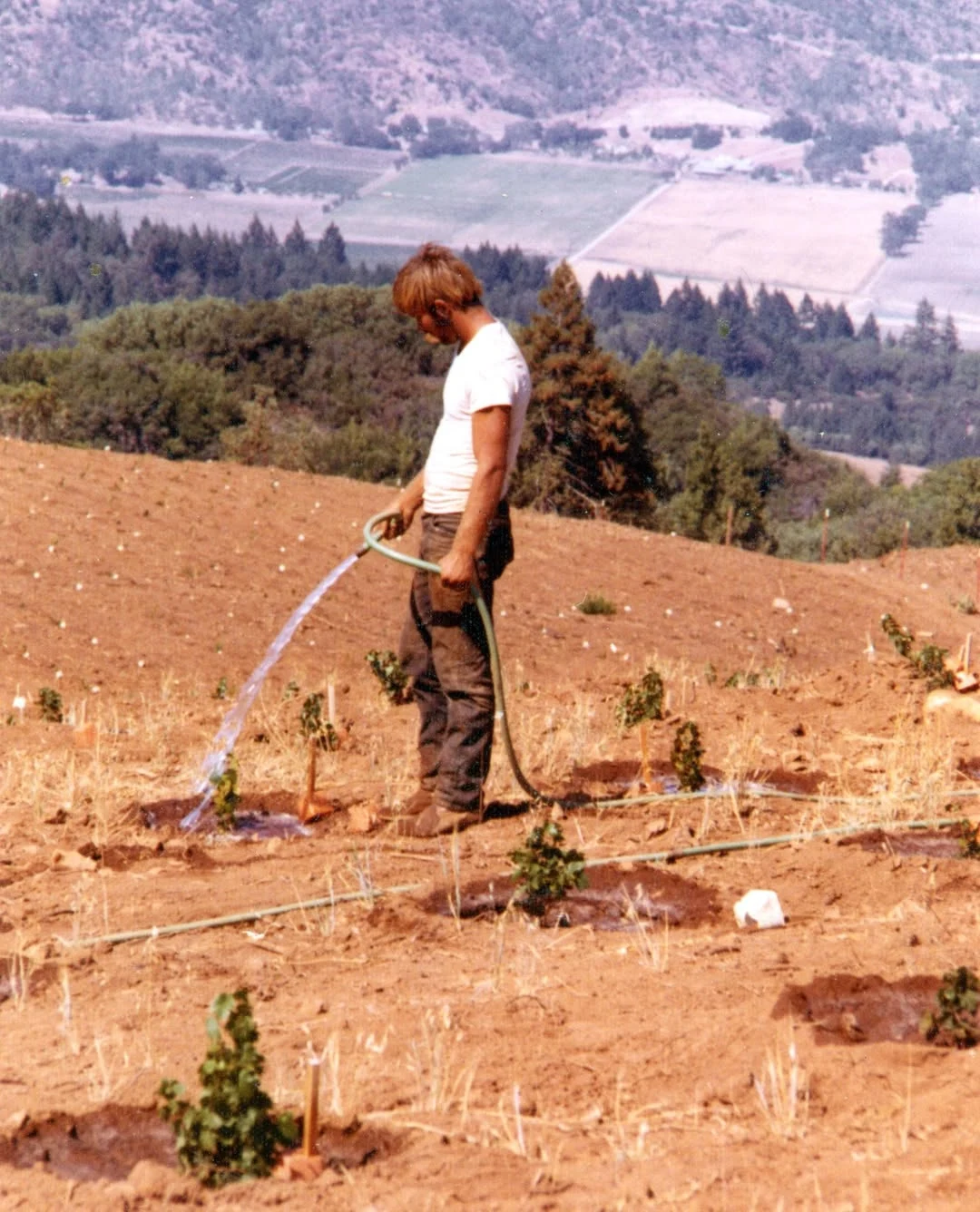
We’ve had a lot of questions about this photo: here’s a longer explanation:
This photograph, taken in 1972, shows Stu watering the first virus-free grapevines ever planted in Napa County. He got them via the Foundation Plant Material Service at UC Davis. These were the first commercially virus free plants planted in Napa County. Because they were the very first they weren’t traditional planting material; they came in 4” plastic containers, the way today you get a tomato plant. They were very small. The shoots were only 6” high out of the pot and very skinny. They were on their own roots; there was no rootstock attached to them, so this meant they would be susceptible to phylloxera. He planted 5 acres each of Chardonnay, Riesling, Cabernet Sauvignon, Pinot Noir and one acre of AXR1. The reason he planted them on their own roots was because there was no alternative. There was no rootstock that was equally heat treated, certified and large enough to graft. Why did he do this? “I wanted to get planted and I didn’t want to use standard planting stock because it was full of leaf roll virus. I took a risk with the hope that I would get 15 years or thereabouts of healthy vines before phylloxera would get them. While there had been vineyards on the property in the 1880s there were no signs of vines left. Phylloxera needs to grow on grapevines,” Stu says.
“The bottom line was that I thought I’d get 15 years and I got well over 35 years out of these vines before they succumbed to phylloxera,” he adds.
“Because we were remote and separated from any neighboring vineyards whether from anywhere in the Valley or even on Spring Mountain, we became Increase Block #91 as designated by the FPMS. We were inspected and certified and all of the cuttings that came off our vineyards at that time were sold as certified heat treated and true to type of variety,” Stu says.
Being able to sell those cuttings to other wineries helped the winery survive in the early years.
Stu’s brother Charlie joined the operation at that time and the brothers built a small greenhouse out of clear plastic as the home for the cuttings. “As these vines grew we knew we needed to expand so we made our own bench grafts,” Stu explains.
“We cut the canes; we cut the rootstock; we then stapled the scion on to the rootstock; we callused them in a warm area where the grafts would callus in sawdust; we took cuttings and planted them in the best, least rocky soil we had; we grew them for a year. We called the area where we grew the cuttings the Nursery Block. The first cuttings grown in the Nursery Block went into a block that we call the Benchgraft Cabernet and to this day the Benchgraft Cabernet is one of our best producing vineyard blocks,” Stu says.
“Today the wine industry in Napa Valley is dealing with diseases like red blotch and the leaf roll complex virus but 50 years ago I feel very proud of being part of the effort to get clean virus free plants into the Napa Valley,” Stu explains.
Share this:
2010 Cook’s Flat Reserve is ReleasedDecember 4, 2013In “2010 Cook’s Flat”
Celebrate our 50th Anniversary!May 15, 2021In “Vineyard News”
The New York Times looks at the impact of the wildfiresJuly 22, 2021In “Vineyard News”Author SanityPosted on Categories